Food Assistance › Guide
Emergency Food Near You: How TEFAP, CSFP Senior Boxes, and Food Banks Work
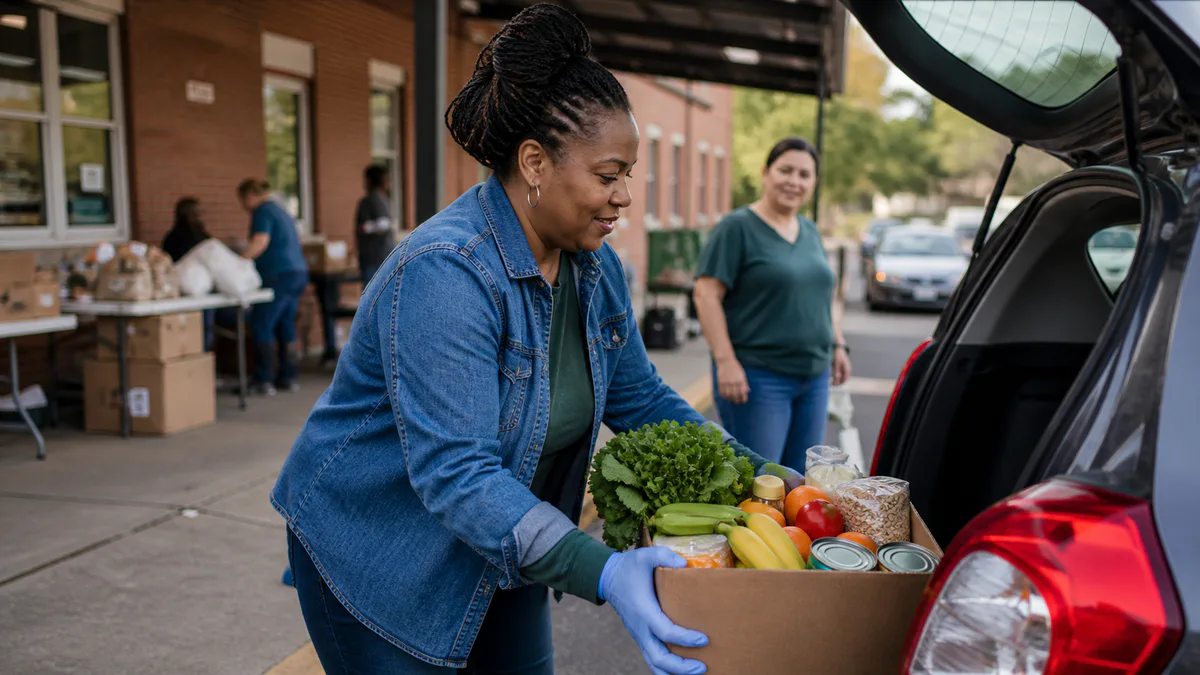
Need groceries this week? Two federal programs send free food to pantries and senior centers near you.
Need food today? Call the USDA National Hunger Hotline at 1-866-348-6479, Monday through Friday, 8 a.m. to 8 p.m. Eastern. You can also text 914-342-7744. Ask which local pantry or meal site is open before you go.
The Emergency Food Assistance Program (TEFAP) gives USDA food to food banks. Anyone who meets their state's income rules can use it.
The Commodity Supplemental Food Program (CSFP) sends a monthly box of shelf-stable groceries. That means food that keeps without a fridge. CSFP goes to lower-income adults age 60 and older.
You do not apply to the federal government for either program. Both work through state agencies, food banks, and local pantries near you. Applying is always free.
You do not need an official yes before you get food today. The fastest way to reach food is the USDA National Hunger Hotline, no matter which program might fit you. Call or text it, and it connects you to the nearest food bank, pantry, or meal site.
No real food program will ever ask you to pay. You never pay to get on a list. You never pay to get a box of food.
What is TEFAP, and who can get it?
TEFAP is a federal program. It gives free emergency food to people with low income.
USDA buys the food and ships it to state agencies. Those agencies send it to local food banks. The food banks give it out through pantries and soup kitchens. Some send it straight to households through community groups.
Each state sets its own TEFAP income rules. There is no single national income cutoff. If you eat a meal at a soup kitchen or similar site, you are presumed to have low income. You do not need to prove it.
If you take food home instead, your state sets the income limit. That limit decides if you may qualify. Some states also let you qualify automatically if you already get help from another income-based program.
What is CSFP, the senior food box program?
CSFP is for adults age 60 and older with lower incomes.
If you're accepted into CSFP, you get a food package each month. It has items like milk, cheese, juice, cereal, rice, pasta, peanut butter, canned meat or fish, and canned fruits and vegetables. It adds to your diet. It is not a full month of groceries.
Every state agency or Indian Tribal Organization that runs CSFP sets its own income limit. That limit must be at or below 150% of the Federal Poverty Guidelines. Those guidelines are the yearly income lines the government uses to measure poverty. Some states set the limit even lower, so your exact cutoff depends on where you live.
As a reference point, the 2026 federal ceiling is $23,940 a year. That is for a one-person household in the 48 contiguous states, D.C., and Puerto Rico. The number is higher in Alaska and Hawaii. It also rises with household size.
States may also ask a doctor or local agency to confirm your diet puts your health at risk. CSFP is not offered everywhere. It runs in parts of all 50 states plus several tribal areas. Check whether your county takes part.
How do food banks and pantries work?
A food bank is a regional warehouse. You do not walk in and pick up groceries there yourself.
Food banks collect food from TEFAP shipments, stores, manufacturers, and other sources. They store it and send it to local partners — food pantries, soup kitchens, senior centers, and community groups. Those local partners hand you the actual bag or box of food. They usually work on a set schedule. Sometimes it's just a sign-in instead of a full application.
The same regional food bank often sends out both TEFAP shipments and CSFP boxes. It sends both to its local partners. So one visit to a food pantry can sometimes connect you to both programs, plus other help the site knows about.
How are TEFAP and CSFP different from SNAP?
TEFAP and CSFP give you real food — a box or bag of set items.
The Supplemental Nutrition Assistance Program (SNAP) works differently. It is a monthly benefit loaded onto an EBT card. You use the card to buy groceries you choose at stores that accept it. SNAP income and asset rules also vary by state.
You can use TEFAP or CSFP even if you already get SNAP. They do not cancel each other out. See our food assistance hub for how SNAP and other food programs fit together.
Do you already get Supplemental Security Income (SSI)? It is worth checking CSFP too. SSI payments are low. Many states set their CSFP limit at or near the federal 150%-of-poverty limit. In those states, many SSI recipients fall under that limit without extra steps.
Our SSI page covers current federal payment amounts and how SSI works with other benefits.
What to do next
- Call or text the USDA National Hunger Hotline: 1-866-3-HUNGRY (1-866-348-6479). Hours are Monday–Friday, 8 a.m.–8 p.m. ET. You can also text 914-342-7744. This is the fastest way to find a food pantry or meal site near you today.
- Find your state's TEFAP state agency contact. Ask about local income rules and nearby food sites.
- Find your state's CSFP state or tribal agency contact. Ask if your county takes part, and how to apply for the senior food box.
- Can't reach the hotline? Search a national food bank network, like Feeding America's food bank locator, to find a pantry near your zip code.
- Ask about other help while you are there. Many pantries and local benefits offices can check on the spot whether you may qualify for SNAP, cash help, or other programs. See our cash assistance hub for programs that free up money for food and other costs.
Your next step. The free SNAP screening guide explains what your SNAP office needs to check and how to find the official application route. It does not calculate a SNAP award. All tools →